
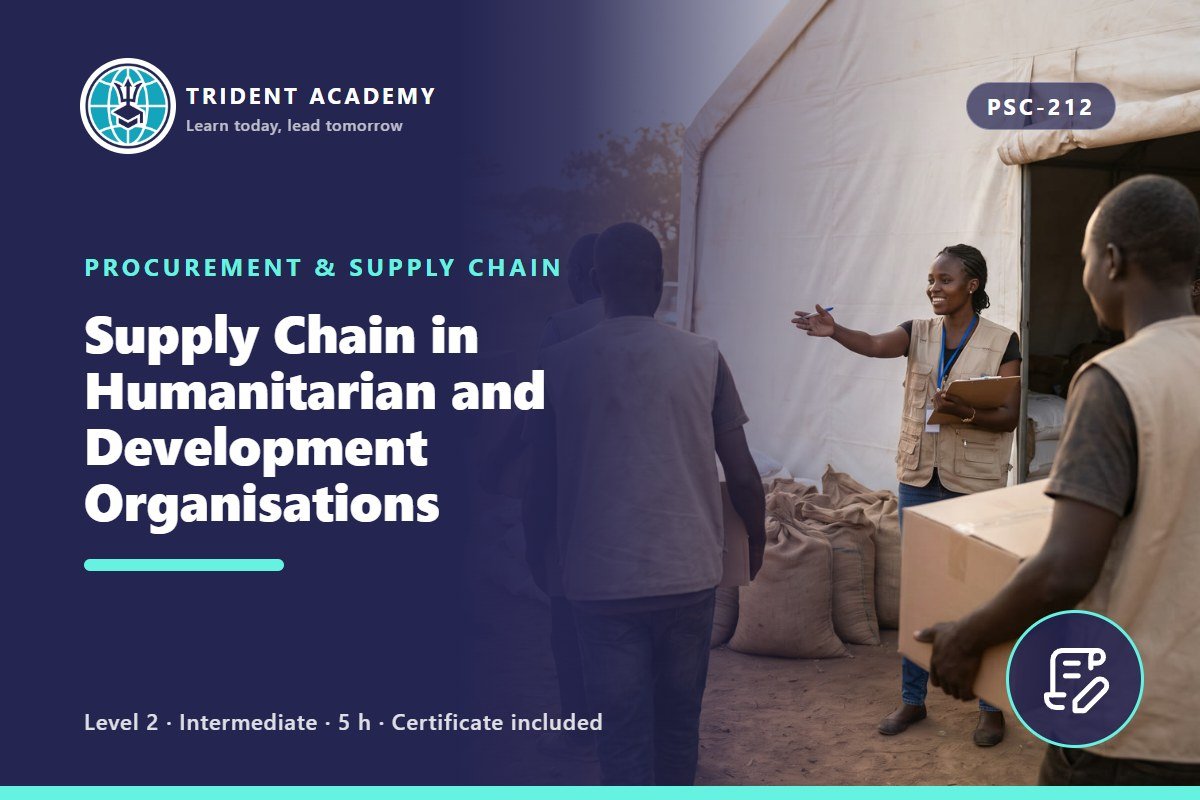
Supply Chain in Humanitarian and Development Organisations
English
US$59
- FieldProcurement & Supply Chain
- Level2 · Intermediate
- Duration5 h
- Course languageEnglish
- IncludesNarrated videos, interactive activities, final assessment and a verifiable certificate
Instant course access as soon as payment is confirmed.
🌐 This course is in English. You need to be fluent in English to follow it.
Prerequisites: PSC-601 Introduction to Procurement and the Supply Chain
🔒 This course opens once you complete: PSC-601 Introduction to Procurement and the Supply Chain
Or include this course in an annual plan — from US$499/year · See plans ›
🎓 Studying procurement? The Executive Programme opens on 11 January
An advanced Procurement and Supply Chain programme with limited places, by application. People on the waiting list hear first and get priority.
Notify me →When a flood leaves thousands of families homeless, the goods they need have to be bought, stored and distributed in days, not months, without losing control or the trail of every item. This Level 2 course shows how the supply chain of humanitarian and development organisations works: the phases of a response, the actors, the humanitarian principles and the minimum standards of the Sphere Handbook; emergency procurement, with pre-positioning, standby framework agreements, simplified and justified procedures and standard kits; donor procurement and reporting rules, including eligibility, thresholds, checking suppliers against sanctions lists and supporting documentation; warehousing in difficult settings, with temporary warehouses, stock cards, waybills and in-kind donations; and distribution right to the last mile, with beneficiary registration, distribution points, cash transfers and post-distribution monitoring. It includes a decision scenario, a compliance checklist, hotspots and a case study. The specific rules depend on each organisation and each donor, and your organisation's security rules always take precedence.
What you will learn
- Distinguish the emergency supply chain from the development supply chain and place the main actors, principles and standards.
- Apply emergency procurement procedures without losing control or traceability.
- Comply with donor procurement and reporting rules, including supplier checks and supporting documentation.
- Organise temporary warehouses and stock control in a humanitarian setting.
- Plan distribution to beneficiaries with safety, dignity and traceability.
Modules
- The humanitarian and development context57 min
- Emergency procurement53 min
- Donor rules and accountability61 min
- Warehousing in difficult settings54 min
- Distribution and the last mile60 min
Who it is for
NGOs, development agencies, donor-funded programmes
Only logged in customers who have purchased this product may leave a review.
Related products
-
English




Reviews
There are no reviews yet.