

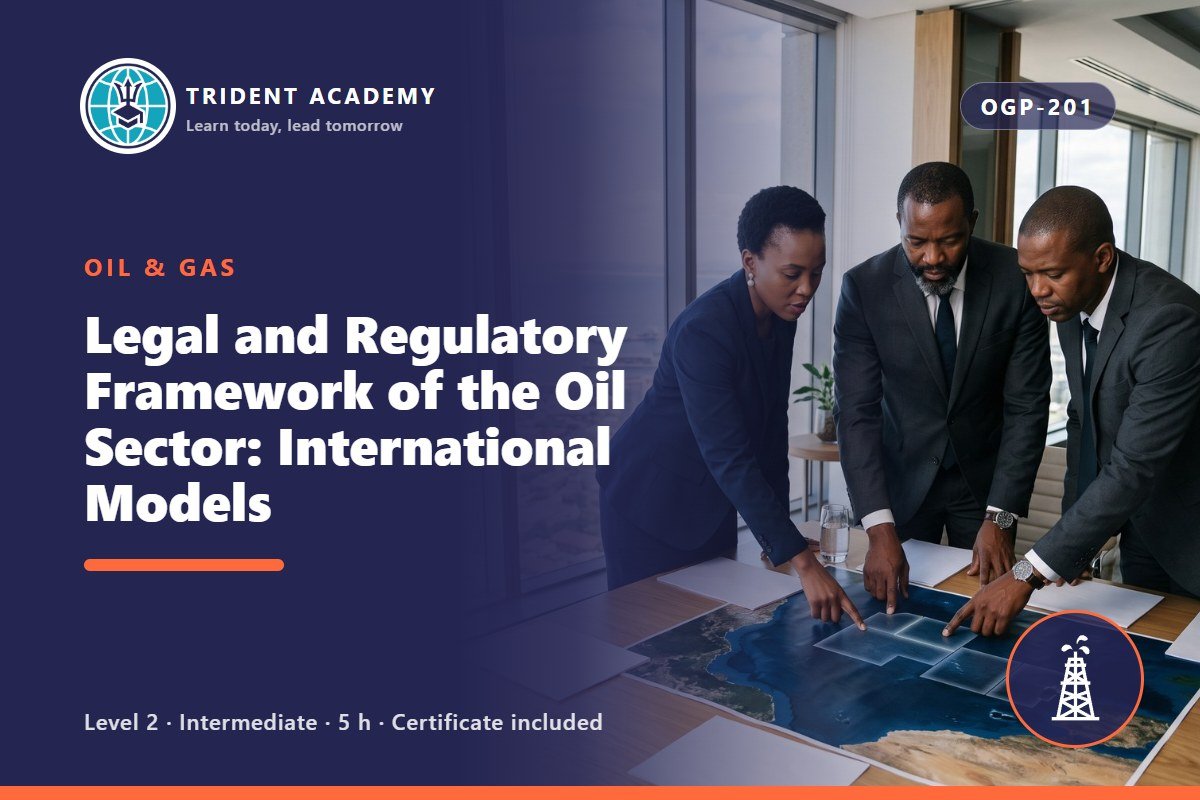
Legal and Regulatory Framework of the Oil Sector: International Models
English
US$79
- FieldOil & Gas
- Level2 · Intermediate
- Duration5 h
- Course languageEnglish
- IncludesNarrated videos, interactive activities, final assessment and a verifiable certificate
Instant course access as soon as payment is confirmed.
🌐 This course is in English. You need to be fluent in English to follow it.
Prerequisites: OGP-601 Introduction to the Oil and Gas Industry
🔒 This course opens once you complete: OGP-601 Introduction to the Oil and Gas Industry
Or include this course in an annual plan — from US$499/year · See plans ›
Who owns the oil, who decides who may produce it and how is the revenue shared? In this course, designed for professionals and candidates for the oil sector and for suppliers, you will follow the new business team of a fictitious operator as it analyses countries, contracts and partners. Understand sovereignty over natural resources and the State's policy, regulatory and commercial roles, with the ministry, the regulator, the national concessionaire and the national oil company (NOC). Compare the concession or licence, with royalties and taxes, the production sharing contract, service contracts and joint operating agreements (JOA), with illustrative numerical examples. Describe bid rounds, award criteria and the phases of a contract, from exploration to abandonment, and evaluate the bids in a fictitious round. Distinguish the roles of the NOC, the international oil companies (IOC), the operator and the non-operators, including carried interests and the management of conflicts of interest. Finally, identify the obligations on transparency under the EITI Standard 2023, local content, the environment, safety and decommissioning. Aligned with the Natural Resource Charter and the EITI Standard 2023. It presents international models; it is not legal or tax advice.
What you will learn
- Explain who holds petroleum resources and how the State organises the sector, distinguishing the policy, regulatory and commercial roles.
- Compare the concession or licence, the production sharing contract, service contracts and joint operating agreements.
- Describe how blocks are awarded, the award criteria and the phases of a petroleum contract, including the relinquishment of areas.
- Distinguish the roles of the national company, the international companies, the operator and the non-operators, including carried interests.
- Recognise conflicts of interest in the relationship between partners and in the governance of the national company, and indicate how they should be managed.
- Identify the cross-cutting obligations of a petroleum contract: transparency (EITI Standard 2023), local content, the environment, safety and decommissioning.
Modules
- Petroleum resources and the role of the State57 min
- Contract models57 min
- Licensing and block award56 min
- NOCs, IOCs and partners57 min
- Transparency and other regulatory obligations58 min
Who it is for
Professionals and candidates for the oil sector, and suppliers
Only logged in customers who have purchased this product may leave a review.



Reviews
There are no reviews yet.