

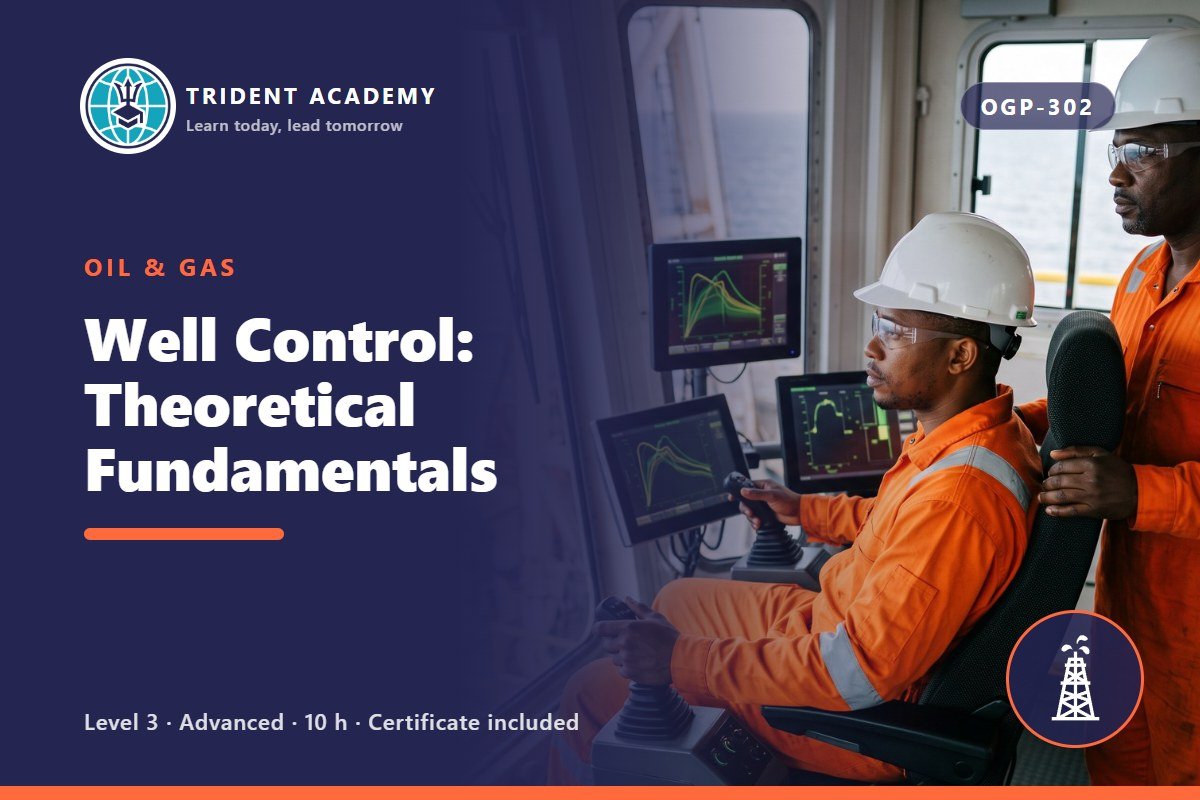
Well Control: Theoretical Fundamentals
English
US$129
- FieldOil & Gas
- Level3 · Advanced
- Duration10 h
- Course languageEnglish
- IncludesNarrated videos, interactive activities, final assessment and a verifiable certificate
Instant course access as soon as payment is confirmed.
🌐 This course is in English. You need to be fluent in English to follow it.
Prerequisites: OGP-703 Fundamentals of Well Drilling and Completion
🔒 This course opens once you complete: OGP-602 The Value Chain: Upstream, Midstream and Downstream, OGP-703 Fundamentals of Well Drilling and Completion
Path: OGP-602 → OGP-703 → OGP-802
Or include this course in an annual plan — from US$1,649/year · See plans ›
On a well being drilled, all that separates the reservoir from the surface may be a column of fluid and a set of valves. In this advanced, theoretical course for oil and gas professionals, industry candidates and suppliers, you follow the crew of a fictitious rig on a development well. Calculate hydrostatic pressures and relate pore pressure, fracture pressure, equivalent circulating density and maximum allowable annular surface pressure. Recognise the causes and warning signs of a kick and use the trip sheet. Explain the two-barrier principle and barrier envelopes, identify well control equipment and its tests, put the general shut-in steps in order and interpret shut-in pressures. In a theoretical exercise, calculate the kill mud weight and the pumping schedule for the Driller's Method and the Wait and Weight Method, and analyse, in general terms, the lessons of Montara and Macondo and the role of human factors. Aligned with API Std 53, IOGP Report 476 and ISO 16530-1. A theoretical, preparatory course: it does not replace certified practical training, IWCF or IADC WellSharp well control certification, or practical simulator exercises.
What you will learn
- Calculate hydrostatic pressures and relate pore pressure, fracture pressure, ECD and MAASP.
- Recognise the causes and warning signs of a kick and use the trip sheet to detect them.
- Explain the two-barrier principle, barrier envelopes and how they are verified.
- Identify well control equipment, its function and the tests that prove it works.
- Put the general steps for shutting in a well in order and interpret the pressures and volumes recorded.
- Calculate, in a theoretical exercise, the kill mud weight, the circulating pressures and the pumping schedule.
- Analyse lessons from well control incidents and the role of human factors, communication and stop work authority.
Modules
- Well pressures90 min
- Kicks: causes and warning signs80 min
- Well barriers80 min
- Well control equipment79 min
- Shutting in the well87 min
- Well kill methods90 min
- Lessons from accidents and human factors79 min
Who it is for
Oil and gas professionals, candidates for the oil and gas industry, and suppliers
Only logged in customers who have purchased this product may leave a review.
Related products
-
English

-
English



Reviews
There are no reviews yet.